How to Verify Someone on a Dating App Before You Meet
Most people on dating apps are who they say they are. The ones who aren’t can cost a lot. The FTC received 64,003 romance scam reports in 2023, with $1.14 billion in reported losses and a median loss of $2,000 per person, according to its own figures.
Checking a match doesn’t need to feel like an investigation. The steps below take about ten minutes, and a real person will pass them easily.
Red flags to watch for in the chat
Before running any checks, pay attention to how the conversation goes. Romance scams follow a script, and these signs show up again and again:
- They want to move off the app quickly, to WhatsApp, Telegram, or email, where the dating app can’t flag or ban them.
- Intense affection very early, such as talk of love, marriage, or fate within days.
- They can’t video call. The camera is broken, the connection is bad, or they’re somewhere calls aren’t allowed.
- They work far away, often on an oil rig, in the military overseas, or as a doctor with an international organization, which explains why they can’t meet.
- A sudden crisis that needs money, like a medical bill, customs fee, or frozen bank account. In the FTC’s 2022 data, this was the most common lie in romance scam reports.
- An investment tip, usually crypto, that they’ve supposedly made a fortune from. Their story often reads as a success they want to share with you.
One of these on its own can be innocent. Several together is a pattern.
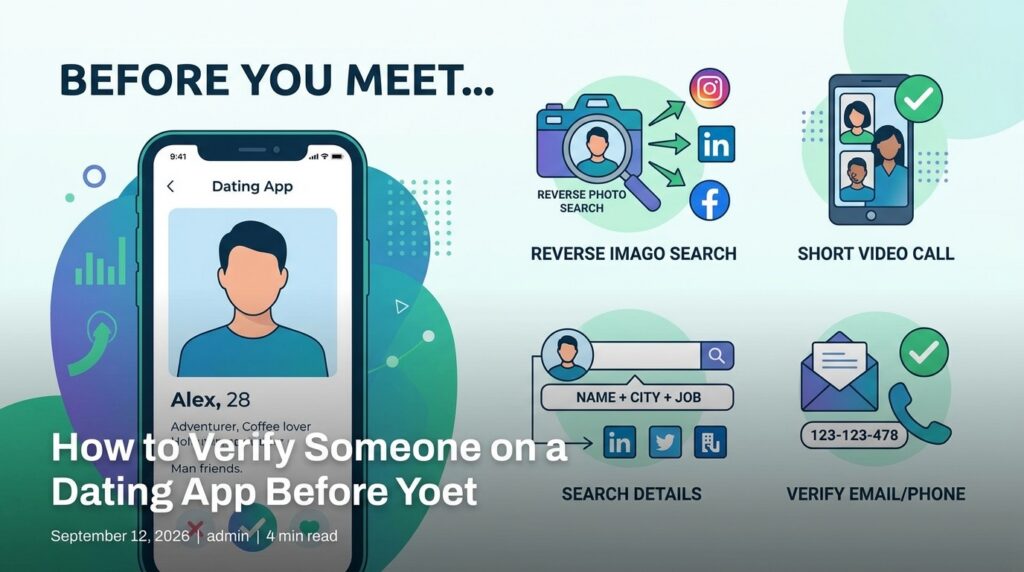
Step 1: Reverse search their photos
Scammers rarely use their own face. They take photos from models, influencers, or ordinary people’s social media.
Save one or two of their profile photos and upload them to Google Lens (images.google.com, then the camera icon) or TinEye. If the same photos appear under a different name, on a stock photo site, or on an Instagram account with thousands of followers, you’re not talking to that person.
Try more than one photo. Scammers sometimes use pictures that don’t return results, so a clean search on one image isn’t proof.
Step 2: Ask for a short video call
This is the single most effective check. A two-minute video call confirms the person matches their photos, and scammers avoid it almost without exception. A real match might be nervous about it, but they won’t have an excuse every time for weeks.
Be aware that deepfake video exists. If a call feels off, for example with odd lighting around the face or a refusal to turn their head, ask for something spontaneous, like waving or holding up a specific object.
Step 3: Search their name and details
Search their first name together with details they’ve shared: city, job, school, or employer. Someone who says they’re a nurse in Denver or an engineer at a specific company usually leaves some trace, like a LinkedIn profile, a professional listing, or tagged photos.
Check the social profiles you find for consistency. Very new accounts, few friends or followers, and no posts older than a few months are typical of fake profiles.
Step 4: Check the email or phone number they gave you
Once a match moves to email, you have something concrete to check. A free dating scam check shows whether the address is real and whether it comes from a disposable inbox service, which fake profiles use often.
A full report goes further and shows the accounts, names, and profile photos linked to the address. If their email is connected to a different name, or to photos of someone else, you have your answer. If it’s connected to the same name and face they showed you on the app, that’s reassuring. The person is never notified that you checked.
For more ways to trace an address, see how to find social media accounts by email.
Step 5: Ask questions only a real local would answer
If they claim to live in your city, mention a well-known local place and see how naturally they respond. Scammers often work from scripts and avoid specifics, or answer with details that are slightly wrong.
If something doesn’t add up
- Stop sending money, gift cards, or personal information, including photos you wouldn’t want shared.
- Report the profile in the dating app. It helps get the account removed before it targets someone else.
- Report the scam to the FTC at ReportFraud.ftc.gov, or to the FBI’s IC3 if you’ve lost money.
- Talk to your bank right away if you’ve sent a payment, since some transfers can still be stopped.
Scammers sometimes return posing as a lawyer or investigator who can recover your money for a fee. That is a second scam.
When you do meet
Once someone passes these checks, meet in a busy public place, arrange your own transport, and tell a friend where you’ll be and who you’re meeting. Verification lowers the risk, and a sensible first date lowers it further.
Frequently asked
How can I tell if a dating profile is fake?
Common signs are photos that appear under other names in a reverse image search, refusal to video call, pressure to leave the app, and any request for money or crypto.
Is it OK to look someone up before a first date?
Yes. Checking public information about a match is a common safety step. Keep it to verification, and don't use what you find to pressure or embarrass them.
What should I do if my match is a scammer?
Stop sending money or personal information, report the profile in the app, report it to the FTC or IC3, and contact your bank if you have already paid.
Keep reading
-
Scam & Safety Guides
How to Tell If an Email Is a Scam: 10 Checks
Ten checks that expose scam and phishing emails, from the real sender address and lookalike domains to SPF and DMARC…
-
Reverse Email Guides
7 Best Epieos Alternatives for Email, Phone, and Username Lookup
Epieos works well but gets pricey for occasional use. Here are seven alternatives for email, phone, and username lookups, from…
-
Reverse Email Guides
How to Find Out Who Owns a Gmail Address
Google won't tell you who owns a Gmail address, but the owner's public name, photo, reused username, and linked accounts…