How to Find Out Who Owns a Gmail Address
Gmail addresses are the hardest kind to trace. A work address like j.smith@acme-logistics.com tells you the company straight away. A Gmail address tells you nothing, except that someone signed up for a free Google account. Yet Gmail is exactly what most scammers, fake profiles, and anonymous senders use.
Google won’t tell you who owns an address. It only discloses account holder information to law enforcement with legal process, such as a subpoena or court order. What you can do is look at what the owner has made public, and there’s often more than you’d expect.
Start with how Gmail addresses work
Two Gmail rules affect how you search:
- Dots don’t matter. Gmail ignores periods in the username, so
jane.doe@gmail.com,janedoe@gmail.com, andj.a.n.e.doe@gmail.comall reach the same inbox. Search every version you’ve seen. - Plus tags are ignored too.
janedoe+shopping@gmail.comdelivers tojanedoe@gmail.com. Remove the tag before searching.
Also note that googlemail.com is the same service as gmail.com and was used in some countries.
1. Check the name and photo on the Google Account
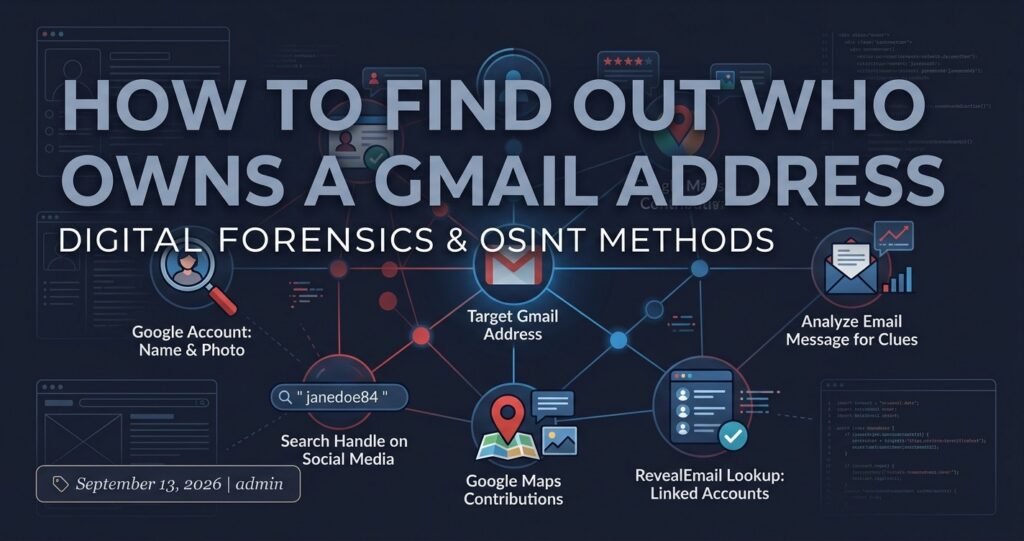
Every Gmail address belongs to a Google Account, and many owners add a name and profile photo. You can often see them without any tools:
- If they emailed you, open the message in Gmail. The sender’s profile photo appears next to their name, and hovering over the name shows a card with their account details.
- If they didn’t, start a new email to the address in Gmail, or add it to your Google Contacts. Gmail may show the account’s photo when you do.
A real name and a personal photo that match what they told you is a good sign. A blank profile doesn’t prove anything, since many people never set one.
2. Search the address and the username
Search the full address in quotes, "janedoe84@gmail.com", to find any page where it’s published: forum posts, online CVs, classified ads, or old guestbook pages.
Then search the username on its own, "janedoe84". People reuse the same handle on Instagram, Reddit, gaming platforms, and marketplaces, and those profiles often show a real name or face. Confirm a match with details like location or photos, because short handles are shared by many people.
3. Look for public Google activity
A Google Account can carry public activity that points back to a person. The most useful is Google Maps contributions: reviews and photos left under the account’s name, which can reveal a home area or workplace. Tools such as Epieos and the open-source GHunt check the Google side of an address and show what’s public, including Maps reviews when the owner hasn’t hidden them. See our Epieos alternatives comparison for the options.
4. Check where else the address is registered
Most Gmail users sign up for other services with the same address. A lookup tool can check which accounts exist for it without notifying the owner.
RevealEmail’s email owner check starts with a free check of the address, then a full report shows linked accounts, names, and profile photos across the sources it searches. Reports start at $3.95 for 3, with no subscription. If you’re mainly after social profiles, our guide to finding social media accounts by email covers the free methods in detail.
5. Look at the email itself
If the address sent you a message, the message has clues:
- What name did they use, and does it match the Google Account name?
- When was the address first used with you, and does it look newly created, like a name followed by a long string of numbers?
- Did they sign with a job title or company? Search it, and check whether that company would really use a Gmail address.
For mail sent from the Gmail app or website, Google leaves the sender’s IP address out of the message headers, so you can’t get a location from them, whatever older guides claim.
When a Gmail address is a warning sign
A Gmail address is completely normal for personal email. It’s a warning sign when someone uses one to represent an organization that would have its own domain: a bank, a government office, a large company’s HR department, or a lawyer handling an inheritance. If you’ve received a message like that, run through our guide on how to tell if an email is a scam.
Know the limits
Some Gmail addresses can’t be traced. A new account with no name, no photo, no reused username, and no sign-ups elsewhere leaves nothing to find. That’s common for addresses created for one purpose, including scams. It’s also common for people who simply value their privacy.
Use what you find to protect yourself, not to harass or expose anyone. Results from public sources also can’t be used for decisions about employment, housing, credit, or insurance.
Frequently asked
Will Google tell me who owns a Gmail account?
No. Google only discloses account holder information to law enforcement with legal process, such as a subpoena or court order.
Can I find a location from a Gmail address?
Not from the email headers, because Google leaves out the sender's IP address for mail sent through Gmail. Public activity such as Google Maps reviews can sometimes point to an area.
Are jane.doe@gmail.com and janedoe@gmail.com the same?
Yes. Gmail ignores dots in the username and anything after a plus sign, so those variations all reach the same inbox.
Keep reading
-
Reverse Email Guides
7 Best Epieos Alternatives for Email, Phone, and Username Lookup
Epieos works well but gets pricey for occasional use. Here are seven alternatives for email, phone, and username lookups, from…
-
Reverse Email Guides
How to Find Social Media Accounts by Email
Free ways to find the social media accounts linked to an email address, why they often come up empty, and…
-
Scam & Safety Guides
How to Verify Someone on a Dating App Before You Meet
Red flags and five quick checks to confirm a dating match is real: reverse image search, a video call, and…